How to Make More Ads That Grow Your Business
How Cal AI, Wispr Flow and BlendJet used creators, where AI cuts production costs, and how to test more ads on a fixed budget.
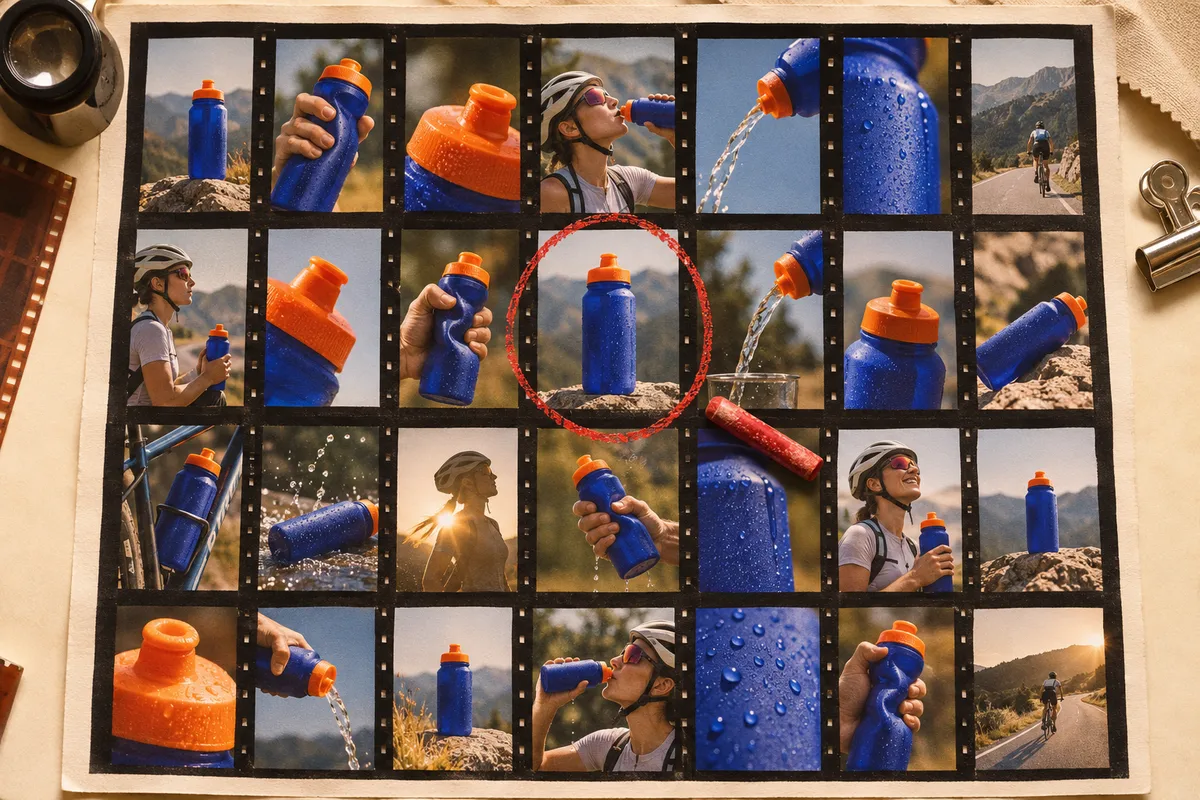
Imagine you sell the blue water bottle on our cover. You can afford one afternoon with a cyclist. What should you film? The bottle catching the morning light? A rider grabbing it one-handed on a climb? Or the moment she turns it upside down over her laptop before trusting it in her bag?
Shoot all three. The first sells the look. The second sells the ride. The third answers the question that might actually be holding up the purchase. You can spend a week arguing about which one belongs in the ad. A well-designed test lets customers settle it, and you still have the footage to make the next round.
That’s the business case for making more ads. Here’s how some teams have done it, and how to borrow the parts that make sense on a smaller budget.
Cal AI found a product demo hiding in a creator format
Fitness creators already had a reason to point a camera at their lunch. Cal AI, an app that estimates nutrition from a food photo, could fit into a “what I eat in a day” video in a few seconds. The creator takes the picture, the estimate appears, and the viewer understands why they might want the app. Try getting that much across in a spoken sponsor read.
Co-founder Jake Castillo says he evaluated over 10,000 influencers and signed 300. His quick screen looked for signs that people cared about the person behind the account. Look at the comments on a creator’s last few posts. Are people asking this runner about her training plan, or would they have left the same fire emoji under any clip of a finish line? Co-founder Zach Yadegari also walks through how the team approached creators in his interview with Greg Isenberg. Read Castillo’s influencer playbook on X · See his 20-second creator screen.
Watch Zach Yadegari on influencer outreach, starting at 25:33
Steal the casting decision. Before you DM anyone, finish the sentence “My product would naturally show up when this creator does ___.” A running coach packing for a race and a commuter packing a laptop can sell the same bottle for completely different reasons. Give each one the product, the claim you can prove and room to deliver it their way. Agree up front on the fee, the posts and whether you can run paid edits from their footage.
Wispr Flow gave creators a reason to make the next good ad
A creator posting to their followers sells you access to an audience. A creator filming a demo for your ad account sells you footage and a point of view. You can buy either or both. The difference matters when you decide how to pay them.
Wispr Flow’s former head of growth, Matt Swulinski, describes bringing an ecommerce approach to software acquisition. Watch his discussion of paid acquisition alongside head of content Hector Serrano’s account of how the team actually supplied those ads. Serrano described 50 creators producing 500–600 paid creator ads a month. Creators earned a share of the media spend behind their ads. An ad the team kept funding could keep paying its creator. Read Serrano’s paid creator playbook on X · Hear his breakdown on Lenny’s Podcast.
Watch Matt Swulinski explain the Wispr Flow growth playbook
For a small app team, the cheapest part to copy is the feedback. Tell a creator which line made people stay, which demo got them to install and whether those users came back. “Film three more” is a much worse brief than “The messy voice note turning into a clean email brought in users who dictated again the next day. What else do you write between meetings?”
How one shoot turns into 750 possible ads
Alex Hormozi breaks a direct-response ad into a hook, the meat (the part that makes the case) and a call to action. Film 50 openings, five bodies and three endings and you have 50 × 5 × 3 = 750 possible cuts. The useful word is possible. A hook about a leaking bottle needs footage that answers the leak question. Pair it with a speech about colour options and you’ve spent money raising an objection you never resolve.
Watch Alex Hormozi build the 750-ad formula
Start with a version one person can shoot. Record three openings for the bottle. “Would you put this next to your laptop?” opens on the bag. “Try opening your bottle halfway up a hill” opens on the climb. “Which one would you leave on your desk?” opens on the colour range. For each, film the matching proof in one uninterrupted take. Keep the offer and ending fixed. You now have three different reasons to buy, and you know what a win for each would mean. Once an angle earns orders, try five new openings against that same proof.
BlendJet bought more reach for a recipe people could already watch
A portable blender looks fairly ordinary sitting on a counter. Put fruit into it, blend a drink away from the kitchen and the portability explains itself. BlendJet worked with food and fitness creators on recipe and life-hack videos, then promoted their posts with TikTok Spark Ads. TikTok reports 28 million-plus impressions and 12,000 conversions for the campaign. The platform doesn’t give a profit figure. See TikTok’s BlendJet campaign breakdown.
There’s a practical buying decision here. If a creator’s recipe is already drawing questions about the blender, negotiate paid usage and test the original post against your current ad. A polished reshoot can wait. First find out whether the questions turn into orders when you pay to reach people outside that creator’s audience.
Where AI actually saves money
For IBM’s Let’s Create campaign, Adobe says IBM used Firefly to generate 200 assets and more than 1,000 marketing variations. Adobe also reports engagement at 26 times IBM’s benchmark. Those figures answer two different questions. The team could make variations quickly, and this campaign drew attention. A founder still needs sales or retention data to know what happened to the business. Read Adobe’s account of the IBM pilot.
On the bottle shoot, use AI to storyboard the spill test before the cyclist arrives. After the shoot, use it to find alternate opening lines in the transcript, rough out a second edit and adapt the captions for another market. Keep the real inverted-bottle shot. A generated image of a dry laptop can illustrate an idea, but only a real test can demonstrate what that particular lid does.
Put production and media on separate lines. Suppose you spend ₹30,000 on media and bring in ₹90,000 in attributed revenue. That’s 3× return on ad spend (ROAS). If AI-assisted editing takes production from ₹20,000 to ₹8,000, you keep ₹12,000 more before other costs at the same revenue. ROAS is still 3×. It rises if the next creative earns more revenue per rupee of media. Track cost per usable ad alongside ROAS so you can see both gains.
What the odds say about making more ads
Suppose, purely for illustration, that each genuinely different idea has an independent 5% chance of beating your current ad. Ten tries give you about a 40% chance of at least one winner. Fifty give you about 92%, using 1 − 0.95ⁿ. Even in that generous model, about eight teams in a hundred could try fifty times and come up empty.
Real ads share an audience, a price, a product and often most of a script. Fifty edits of one weak promise can fail together. And the best-looking result in a big batch can be a lucky purchase. The way to improve your odds is to test different reasons someone might buy, put enough spend behind each to learn something, then ask the strongest one to win again against your current ad with fresh traffic.
The first batch I’d run with ₹30,000
Say you can afford ₹500 in media to acquire a first-time buyer after accounting for product cost, fulfilment, returns and the margin you need. At that target, ₹30,000 buys roughly 60 purchases. Spread it across 750 cuts and each gets ₹40 on average. You could spend the entire budget learning almost nothing about any single ad.
- Pick the decision before the shoot. For the bottle, choose the message that brings in first-time buyers at an affordable cost. For a consumer app, define activation as an action a user takes, such as logging a first meal. Track cost per activated user and the share who log another meal in week two. A cheap install can become an expensive empty account.
- Give a few ideas a fair comparison. In this example, put ₹15,000 across the three bottle concepts and your existing ad in a matched split test. Keep the offer, audience, placement and dates comparable. At your target cost, that’s only around seven or eight buyers per version. Treat a narrow lead as inconclusive. Save the other ₹15,000 for a follow-up.
- Read the drop-off before commissioning the next cut. If people watch the spill test, click, then leave when shipping appears, test the delivered price on the landing page. If people who reach the demo buy but most scroll away before it starts, move the inverted bottle into frame one. Those two diagnoses call for different work.
- Make the winner defend its budget. Run the promising concept against the existing ad again and allow time for purchases or retention to show up. If it holds as spend increases, commission another creator to make the same promise in their own setting. If both ads miss the cost target, keep the remaining budget while you investigate the offer.
At the end of that shoot, I’d want one line in the next brief that nobody could have written at the start. Something like “People bought this cycling bottle because they trusted it next to a laptop.” Once customers tell you that, you know exactly what to film on Monday.